How WBS Simplifies Pilot Training at Asiatic International Corp


Flying High with Organization: How WBS Simplifies Pilot Training at Asiatic International Corp


Picture constructing a plane without a blueprint—only a rough concept of wings, motors, and a cabin. Disorganization, perhaps? Now, picture operating a pilot training program with no clear plan. That's where the Work Breakdown Structure (WBS) is your cockpit control panel—it's getting everything organized, making operations run smoothly, and bringing you to your destination: certified, assured pilots ready to fly.


At Asiatic International Corp (AIC), Pilot Training is not merely about flying aircraft. It's a choreographed process of ground training, flight time, interviews, and resume workshops. How do you handle all these loose ends without encountering turbulence?


Let's explore how WBS assists AIC in keeping its wings level.


✈️ What Is a Work Breakdown Structure (WBS)?

In easy words, a WBS is a flight plan for your project. It divides a large goal into smaller, manageable chunks, beginning from the overall goal (such as training commercial pilots) and splitting off into certain activities and deliverables.


Consider this:

Project: Train pilots

Phase: Ground Training

Deliverable: Master Aviation Theory

Work Package: Finish Module 1: Air Law

Activity: Take 5 classes, sit for a quiz, pass a mock test

Each step is planned out so that nothing slips through the cracks.


🛠 Building the Flight Plan: WBS for AIC's Pilot Training.

Let's examine how AIC uses WBS for its popular training initiative, "Campus to Corp".


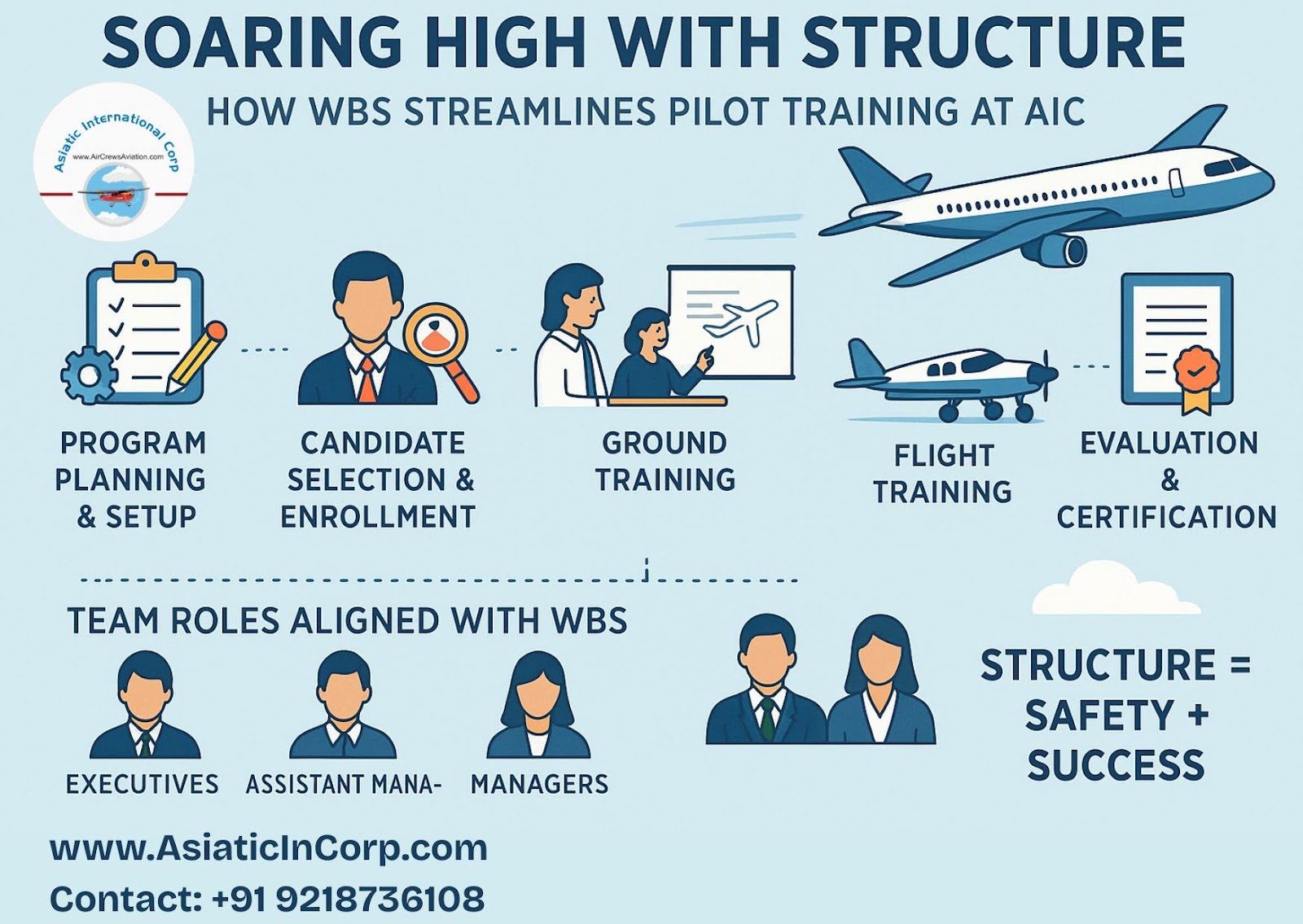
1. Program Planning & Setup

Pre-flight preparation before takeoff. In this, AIC creates a curriculum, assigns trainers, and allows simulators.


2. Candidate Selection & Enrollment

Candidates undergo screening, interviews, and medical fitness tests.


3. Ground Training

This is where students get into aviation theory: weather, navigation, regulations, and aircraft systems.


4. Flight Training

Finally, the excitement—actual flight. From simple taxiing to emergency maneuvers, every flight is logged, tracked, and graded.


5. Evaluation & Certification

Following written tests and check flights, successful students are awarded certifications.


6. Career Counseling & Placement

What distinguishes AIC is its post-training aftercare. Resume refinement, simulation interviews, and job fairs are included in the package.


Team Roles WBS-aligned

AIC's internal organization mirrors the organization of a good WBS:

  • Executives oversee day-to-day check-ins, flight records, and classroom assistance.

  • Assistant Managers span ground and flying instruction, organize evaluations, and interface with trainers.

  • Managers manage the complete training cycle, maintain DGCA compliance, and individually mentor cadets for postings.

By mapping roles against individual work packages, there's absolute clarity—everyone knows what they're doing, by when, and why.


WBS in Action: Milestones & Progress Tracking

Critical milestones are monitored exactly like flight milestones:

  • Ground School Completion ✅

  • Solo Flight ✅

  • Last DGCA Exam ✅

  • Job Placement ✅

This format assists instructors, trainees, and administrators in tracking real-time progress and resolving any setbacks before they become problems.


Why It Works: Real-World Benefits of WBS at AIC

  1.  Clarity: All from trainee to trainer know the play-by-play.


  1. Accountability: Every module has an owner. No task is left suspended.


  1. Efficiency: Resources such as aircraft, simulators, and instructors are scheduled wisely.


  1. Motivation: Trainees can see how they progress step-by-step—it's like ascending a ladder where each rung is labeled clearly.


✨ Final Approach: Organized Success

In the world of aviation, structure = safety + success. And in the world of training, WBS makes sure that no detail falls through the cracks—from the initial day of ground school to that momentous occasion when a cadet receives their wings.


For AIC, a Work Breakdown Structure is not merely a best practice—it's the core of crafting top-notch pilots.


The next time you witness an AIC-trained pilot soaring into the sky, remember that behind the effortless rise are intricately designed WBS, aligning each wing, engine, and dream into perfection.


  • Aiswarya Nelliparambil

  • Project Management

Specialist


Asiatic Intenational Corp.

Immersive Career Counselling in Indore 

Our innovative platform serves as a dynamic pathway, seamlessly fusing your dreams with expert mentorship and immersive content, delivering the best career counselling in Indore. 


Products

Most Successful Female Entrepreneurs of India | Asiatic Intenational Corp. | B601 Leeds Enclave

Most Successful Female Entrepreneurs of India

Successful Female Entrepreneurs of India is a collection of life lessons of successful women from various walks of life from India.

₹1599

Work To Win Book | Asiatic Intenational Corp. | B601 Leeds Enclave

Work To Win Book

Are you tired of spinning your wheels, feeling stuck in a rut, or struggling to achieve your goals? Look no further! ""Work to Win"" offers a proven roadmap to unlock your potential

₹849

Our Services

Counselling for Airline Pilot Training Asiatic Intenational Corp. B601 Leeds Enclave
Counselling For Airline Pilot Training

Airline Pilot Training By Capt Shekhar Gupta Author / Pilot Pilot's Career...   Show more

Online Airline Career Counselling Asiatic Intenational Corp. B601 Leeds Enclave
Online Airline Career Counselling

Online Airline Career Counselling and Books orchestrated by Captain Shekhar Gupt...   Show more

Online Airline Career Counselling Asiatic Intenational Corp. B601 Leeds Enclave
Online Airline Career Counselling

Online Airline Career Counselling and Books orchestrated by Captain Shekhar Gupt...   Show more

Payment QR

Share

Blogs

When the Cabin Light Dims


When the Cabin Light Dims-emotional fatigues seeps in!


Let’s Explore Burnout and Emotional Fatigue beyond Physical Exhaustion


When the final cabin lights dim, the passengers try to control their excitement to reach their destinations. But for those in the Aviation industry- whether you’re flying the aircraft,serving in the cabin or managing ground operations it's not just a prelude to the next step on responsibilities and duties that you need to conduct. Didn’t quite get that? Let us break it down for you.

Have you ever felt that even after getting optimum sleep, you're still hungover from the previous day’s duties or do you feel heavy in your chest thinking about how your day is going to be, when you know very well it’s not your body that is asking for rest, but your mind ?


This is what we like to term as “cabin light dimming” of our own minds! This is a silent yet pervasive reality of emotional fatigue and burnout in our industry, even when we are technically “off duty”.


It is crucial to understand that emotional fatigue is not just being tired. This manifests into various forms which are overlooked by most aviators.

  • Compassion Fatigue:

 This is especially prevalent among cabin crew and ground staff. Why? Because they are always “on” for the passengers. This type of fatigue usually  occurs when there is drainage of energy while de-escalating tense situations and managing emotions, and with time you notice yourselves becoming more emotionless, less caring or even cynical.


  • Decision Fatigue & Hyper-Vigilance Hangover

This is highly prevalent among pilots and air traffic controllers, where shear volumes of critical judgements made under immense pressure leads to mental exhaustion that lingers on while impairing judgements made outside the tower or cockpit. This leaves a residue of restlessness and anxiety throughout the day.


  • Loss of Passion: What might have started as a dream career can begin to feel like a relentless grind. The joy, the wonder, and the camaraderie can slowly erode, leaving behind a sense of detachment.


  • Irritability and Short Fuse: Minor inconveniences or frustrations in daily life can feel magnified, leading to snapping at loved ones or struggling to maintain composure at the workplace.


  • Feeling Disconnected: 

Even when physically present with family or friends, a part of you might feel distant, preoccupied, or unable to fully engage.


If you face similar symptoms, know that you are not “weak”. It’s a sign of your mind and soul asking for help. No one can be pitch perfect every time. 

Even the strongest soldiers fall in the battlefield, what makes them different is their ability to realize what is stopping them to move forward, and work constructively towards the goal.

So what can be done?Let’s not complicate things…..


Start paying attention to the signs than the symptoms. Pay attention to how you feel emotionally. Are you unusually irritable? Disconnected? Lacking motivation? These are signals!

When the cabin light dims, let's ensure it's a signal for rest, recovery, and the opportunity to reignite our own inner light, allowing us to continue soaring, not just physically, but emotionally and mentally too.


Activity Time…

Grab a piece of paper or open one of your fancy notes apps, and respond  to these 4 prompts.

  1. Turbulence: What’s one thing that has startled you this week? Is it restlessness, sudden anxiety or unexpected homesickness?


  1. Clear Skies: Even with such turbulence, what was one moment that gave you “your moment of piece”- A warm smile from a passenger, words of appreciation or seeing your daughter on video call?


  1. Fuel Level: How full is your emotional tank today? (0-100%)


  1. Emergency Protocol: If the tank is too heavy, what’s one small action that you can take to feel grounded?- Take a power nap, talk to your childhood friend or go on a walk?


This exercise is a simple yet impactful step to realize- All that you had to do was Sit. Ponder. Pen down your thoughts….and just like that you found your personal therapy.


What are your strategies for combating emotional fatigue in Aviation? Share your insights and experiences in the comments – your shared wisdom can illuminate the path for others.


Jelin Mariya James

Author / Blogger


Stress In Aviation


How to 

Tackle Aviation Stress

A Practical Guide to Identifying, Addressing, and Healing Aviator’s Mental Health Challenges with the Power of  Basic Oral Therapy  


By 

Capt Shekhar Gupta-

Jelin Mariya James


Let’s explore what’s beneath the Uniform A Saga of Silent Struggles


Let’s explore what’s beneath the Uniform 

A Saga of Silent Struggles!


“You signed up for this!”

How many times have you been slapped by this line, when you tried opening up about what’s troubling you?


Let’s start with a True Story….

A friend of mine, an experienced commercial pilot, once confided in me after a delayed flight. Exhausted, he said, “People see me in these stripes and assume that I’m a machine. Every decision made at 30,000 feet, every delay, and every unanticipated landing- I do feel them. Then there are days I don’t sleep well, or miss my daughter’s birthday, I still have to show up and fly- it’s a lot to bear with sometimes. But the moment I open up about it, I’m told that I “signed up for this”.And that really hurts!”

His story isn’t unique. It’s one of thousands, rarely spoken about publicly but felt deeply by those living it.

This book isn’t about jet lag or lost baggage. It’s about the soul behind the headset and the announcements. It’s about YOU, my fellow Aviator.

               A unique serenity settles in at 35,000 feet, where time seems to pause and the clouds stretch like an endless blanket beneath you.  For passengers, flying is often synonymous with wonder or escape from reality. But for those behind the controls or in the crew, it’s often a very different experience—one that involves immense pressure and expectations, both seen and unseen.


Behind every “calm” Pilot voice saying, “This is your Captain speaking,” there could be a storm brewing—not outside the aircraft, but within.

It’s often believed  that the Aviation Industry is all about pilots and cabin crew, but one must realize that it’s a beautiful amalgamation of every person from the ground staff to the radio towers to the hospitality department to every designation that makes your flight a happy and safe flight experience.

The Aviation industry is celebrated for it’s discipline, precision, and stoicism. But what’s often overlooked is the human cost of upholding such standards under constant high pressure, literally as well as metaphorically.  It’s about the unspoken responsibility of hundreds of lives, the razor-sharp alertness required for every second and the emotional load of always needing to be perfect.


Pilots often navigate irregular sleep patterns, long haul exhaustions and the pain of being away from their loved ones for a long time. Flight attendants are forced to put up with rude customers and unwanted bashing, along with the sleepless nights and tiring schedules. Air traffic controllers work behind the scenes under immense pressure of carrying the weights of countless lives. Why? Because you “signed up for it!”

Whether you’re a Pilot, an Air traffic controller, flight attendant, or ground crew, under that polished uniform lies fatigue, homesickness, anxiety, and sometimes—loneliness.


Stress in Aviation is not an occasional visitor—it’s a constant companion, whether you like it or not. Mental health has long been a taboo in this industry. For many, admitting to stress or burnout can feel like admitting to weakness—a dangerous perception in a field where confidence is critical.

Let’s talk Human to Human,

If you’re in the Aviation Industry and this resonates with you, please remember- You’re not alone. It’s okay to say, “I’m not okay”. It's okay to pause and take care of yourself.

If you’re in the Aviation industry and this resonates with you—know this: you are not alone. You carry the world, sometimes literally, and that takes a toll. It’s okay to say, “I’m not okay.” It’s okay to step back and breathe and take care of yourself.

And if you're a passenger, next time you Fly, perhaps offer a warm smile or a kind word to the crew. Behind the composed expressions and perfect uniforms are people, real people navigating not just the skies but also the weight of silent struggles.


Jelin Mariya James

Author / Blogger


Stress In Aviation


How to 

Tackle Aviation Stress

A Practical Guide to Identifying, Addressing, and Healing Aviator’s Mental Health Challenges with the Power of  Basic Oral Therapy  


By 

Capt Shekhar Gupta-

Jelin Mariya James


Stress In Aviation horizontal line How to Tackle Aviation Stress


 Stress In Aviation


How to 

Tackle Aviation Stress

A Practical Guide to Identifying, Addressing, and Healing Aviator’s Mental Health Challenges with the Power of  Basic Oral Therapy  


By 

Capt Shekhar Gupta

Jelin Mariya James


Part I: 

Understanding Aviation Stress

The Invisible Load: What Is Aviation Stress?

The Psychology of Pilots and Crew Members

The High-Stakes Environment of the Cockpit

Stress vs. Performance in Aviation

Types of Aviation Stress: Chronic, Acute, and Traumatic

The Role of Fatigue and Irregular Schedules

The Impact of Isolation and Time Away from Home

Substance Use and Coping Mechanisms in Aviation

Mental Health Stigma in the Aviation Industry

Recognizing the First Signs of Psychological Burnout


Part II: 

Introduction to Oral Therapy

What is Basic Oral Therapy?

Why Talking Heals: The Neuroscience Behind Verbal Processing

How Pilots Can Benefit from Structured Conversations

Oral Therapy vs. Traditional Counseling: A Practical Overview

The Power of Listening and Empathetic Dialogue


Part III: 

Identifying Core Stress Triggers

Flight Training and Simulator Anxiety

Accident and Incident Aftershock

Fear of Medical Disqualification

Performance Anxiety and Self-Doubt

Navigating Peer Pressure and Hierarchies in Cockpits

Relationship and Family Stressors

Post-COVID Impacts on Pilot Mental Health

Financial Insecurity in Flying Careers


Part IV: 

Oral Therapy in Action

Creating a Safe Space for Aviators to Talk

Guided Questions for Opening Up Conversations

The Listening Partner: Role and Training

Building a Peer Support Network in Airlines

Confidentiality and Ethics in Peer Conversations

Role-Playing Scenarios to Practice Oral Therapy

Case Studies: How Talking Changed a Pilot's Life


Part V: 

Building Resilience and Mental Fitness

Daily Mental Hygiene for Pilots

Developing Emotional Intelligence Through Dialogue

Cognitive Reframing through Guided Oral Techniques

Mindfulness and Verbal Self-Reflection

Gratitude and Storytelling as Healing Tools

Setting Boundaries and Saying No with Confidence

Verbal Journaling: Talking Instead of Writing


Part VI: 

Institutional Support and Culture Shift

Integrating Oral Therapy into Airline SOPs

Training Line Captains as Mental Health Ambassadors

Mental Health Reporting without Repercussions

Creating Supportive Company Culture for Crew

Collaborating with Aviation Psychologists and Therapists

The Role of Unions and Pilot Associations in Mental Wellness


Part VII: [Last Part ] 

The Future of Aviation Mental Health

Using AI and Voice Diaries for Early Detection

The Future Cockpit: Emotionally Intelligent Aviators

A Healthy and Fulfilling Sex Life can play a vital role in reducing Aviation-Related Stress 

and enhancing the overall mental well-being of Aviators

Authors

Capt Shekhar Gupta – Aviator | Trainer | Aviation Wellness Advocate

Jelin Mariya James – MBA Researcher | Co-author of How to Tackle Aviation Stress

Quotes


99% worries we think of Never happened 

The idea that 99% of our worries never actually happen is a common saying and has some basis in research. Studies have shown that a significant portion of our anxieties are about things that don't come to pass. This can lead to wasted energy and emotional distress, as we mentally dwell on potential problems that may not even materialize


Ninety-Nine Percent of the Worries We Imagine Never Come True

"Most of what we worry about never actually happens."

"The vast majority of our fears are just in our heads."

"Almost all our worries are wasted energy on things that never occur."

"99% of the things we stress over never see the light of day.


Understanding Mental Health in Aviators – Daily Struggles, Real Solutions with Professional and Peer Support

A Practical Guide to Identifying, Addressing, and Healing Aviator’s Mental Health Challenges with the Power of  Basic Oral Therapy  


By 

Capt Shekhar Gupta

Jelin Mariya James


Agitation Anguish Anxiety Apprehension Bullying Burnout Confusion Depression Despair Distress Dizziness Emptiness Exhaustion Fear Frustration Grief Hopelessness Insecurity Irritability Isolation Loneliness Melancholy Nervousness Overwhelm Panic Paranoia Rejection Sadness Shame Stress Tension Trauma Uncertainty Worry